
2025 Fall/Winter Newsletter
When our rights are on the line, we fight back.
These last few months have brought no shortage of challenges for our communities. The Trump administration continues to escalate its assault on immigrants, doubling down on brutal and harsh tactics like warrantless arrests and categorically denying bond hearings for immigrants. Emerging technologies, including artificial intelligence (AI) and automated license plate readers like Flock Safety cameras, continue to embed themselves more deeply into our daily lives with significant repercussions.
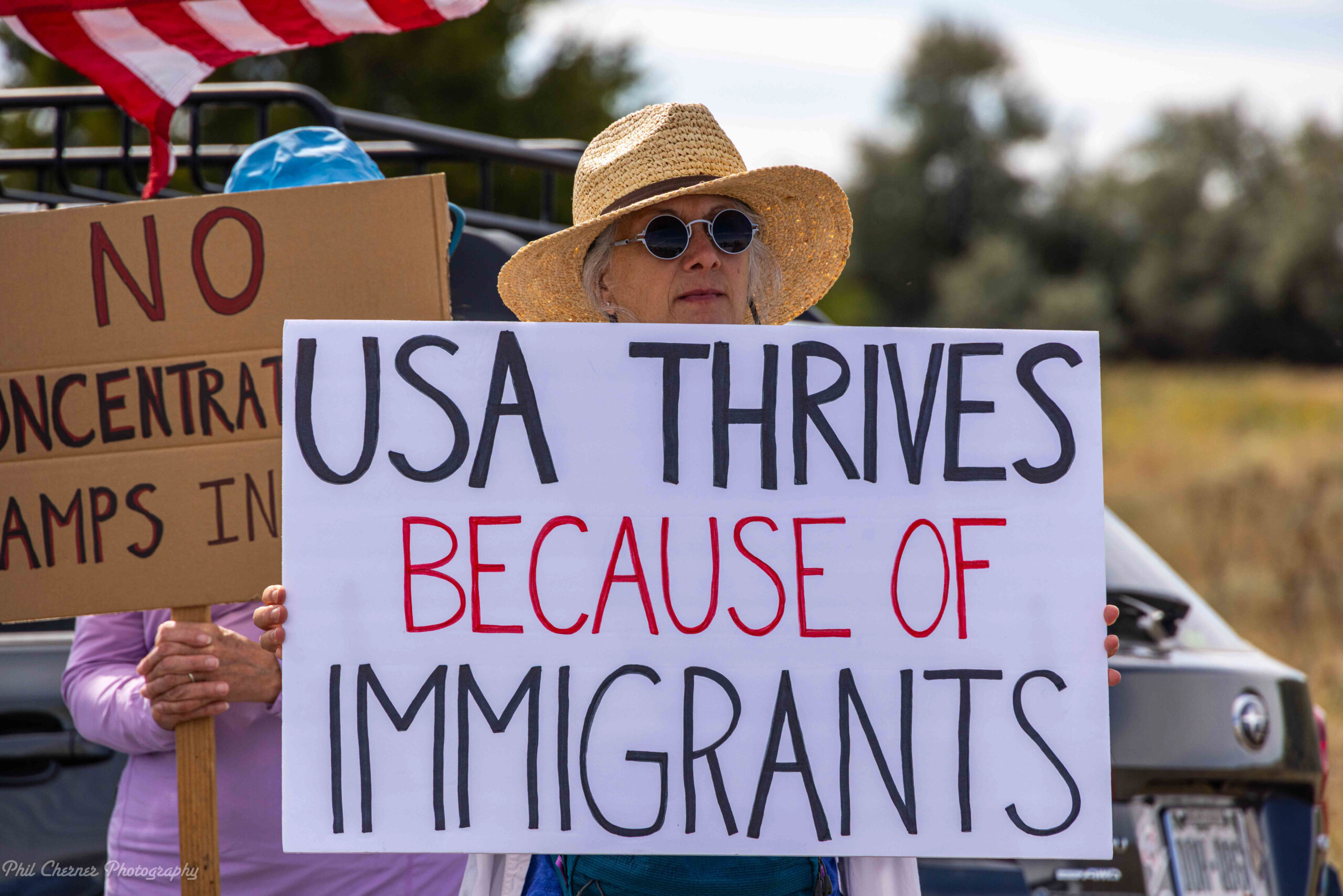
A protester holds a sign outside the Hudson Correctional Facility in Hudson, Colo. September 13, 2025.
However, we are fighting back.
On behalf of our brave clients, our legal team sued to stop Immigration and Customs Enforcement’s (ICE) lawless tactics of conducting warrantless arrests. These warrantless arrests have unlawfully ensnared our loved ones, neighbors, and coworkers in a brutal immigration detention machine that operates with little oversight or accountability. We also successfully sued ICE to free Nestor Esai Mendoza Gutierrez, a longtime Colorado resident and small business owner, and hundreds of others like him; he has since been reunited with his family.
In addition to this litigation, our Policy and Advocacy teams are laying the groundwork to safeguard our privacy from artificial intelligence and surveillance technologies, including by releasing three policy reports focused on AI and leading the charge on a campaign to turn off Denver’s Flock Safety cameras.
Despite these persistent attacks on, and threats to, our constitutional rights, we’ve seen a renewal of something fundamental to our democracy: hope. With hope, our communities have reasserted their rights and pushed back against the Trump administration’s abuses of power. Most of all, our communities are laying the groundwork for a better and more just future.
We’re still in this fight — and we hope you are too.
The Fight to Stop the Trump Administration’s Unlawful Attacks on Immigrants Continues in Colorado Courts
Across the country, there has been a drastic increase in federal immigration enforcement, and discriminatory targeting of immigrants living in the United States. These actions are often in violation of federal and state laws created to protect immigrant rights. In 2025, the ACLU of Colorado filed six different lawsuits challenging unlawful federal government actions in Colorado. We explained some of the lawsuits filed earlier in the year in our 2025 Spring/Summer Newsletter released in June. In the second half of the year, we have filed three additional lawsuits against the Trump administration to protect our immigrant neighbors from the administration’s countless attacks on immigrant communities.
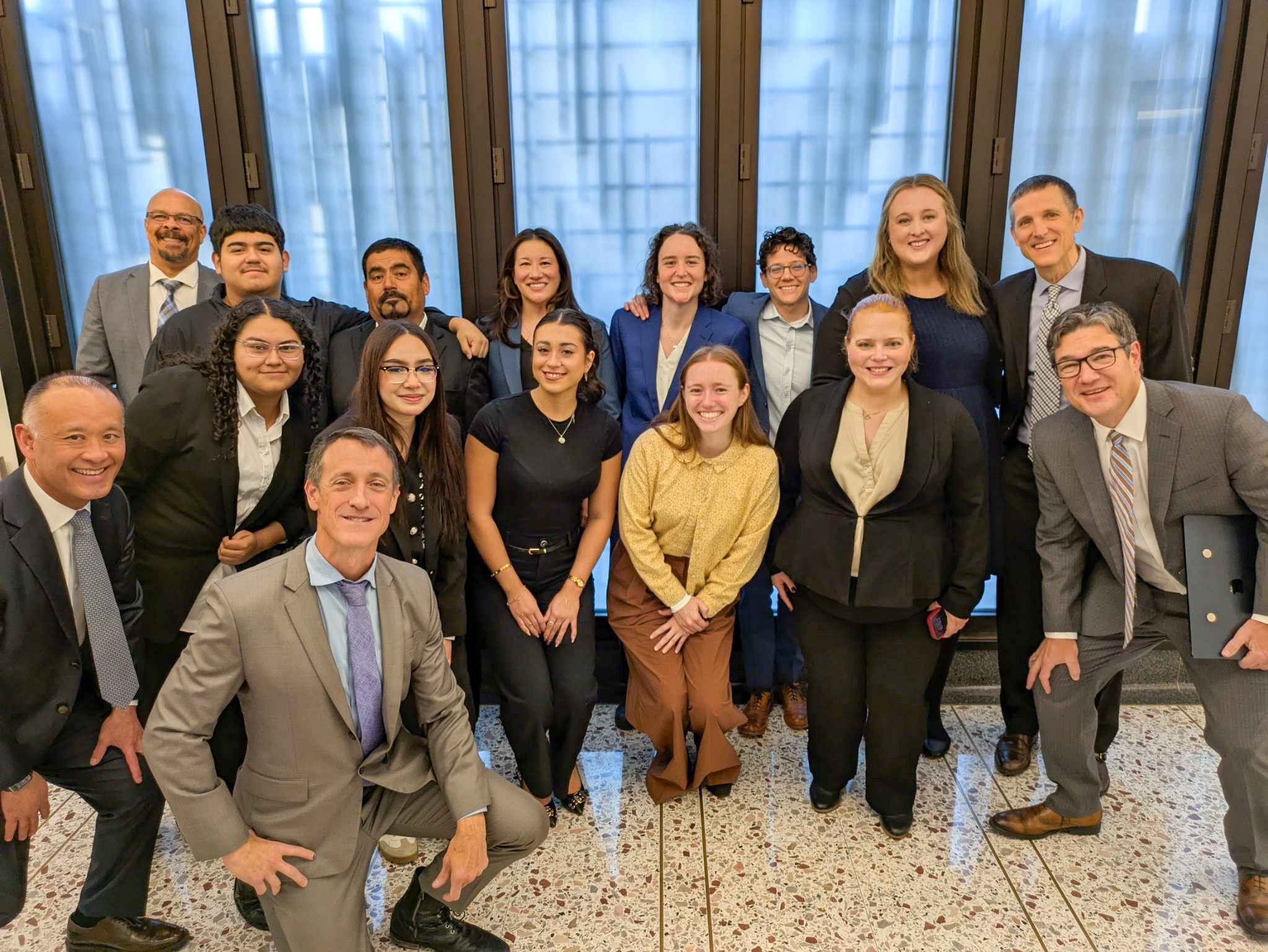
Legal team and plaintiffs in Ramirez Ovando, et al. v. Noem, et al. at the Byron White United States Courthouse in Denver, Colo. October 30, 2025.
Ramirez Ovando, et al. v. Noem, et al.
In October, ACLU of Colorado — with the Meyer Law Office, and Olson Grimsley Kawanabe Hinchcliff & Murray, LLC — filed a class-action lawsuit to stop ICE from conducting warrantless arrests in Colorado without probable cause in violation of federal law. On November 25, 2025, the federal court granted a preliminary injunction and provisional class certification preventing ICE and federal immigration agents from conducting warrantless arrests in Colorado without probable cause that the person is both a flight risk and is in the U.S. in violation of the immigration laws. The court found that ICE has a policy, pattern, and practice of conducting indiscriminate arrests in violation of federal law, all to fulfill arbitrary arrest quotas set by the Trump administration.
The lawsuit was brought on behalf of four plaintiffs:
- Refugio Ramirez Ovando, a 43-year-old father and Lawful Permanent Resident who has lived in Colorado for 20 years.
- Caroline Dias Goncalves, a 19-year-old University of Utah student and Dreamer who was brought to the country as a child and has lived in the U.S. for more than 12 years.
- S.T., a 36-year-old asylum seeker who has lived in Colorado for 15 years.
- R.R., a 32-year-old father and business-owner who has lived in the U.S. for 11 years.
In addition to granting the class-wide preliminary injunction to stop illegal warrantless arrests in Colorado, the court ordered ICE to document the specific, articulable facts supporting probable cause for any warrantless arrests in the state and to regularly provide that documentation to the ACLU of Colorado so that we can monitor ICE’s compliance with the injunction.
Mendoza Gutierrez v. Baltasar, et al.
In September, the ACLU of Colorado filed a federal class action lawsuit challenging a recent Trump administration policy that unlawfully denies bond hearings to immigrants detained by ICE. ICE issued the new policy in July declaring that all people alleged to have entered the country without inspection be denied eligibility for bond during the entirety of their removal proceedings. Millions of immigrants in the country would be impacted, regardless of how long they have been living in the United States.
The lawsuit was brought after Nestor Esai Mendoza Gutierrez, a Denver-area resident and small business owner, was detained. An immigration judge denied his application for bond, citing a new interpretation of the Immigration and Nationality Act, and declared Mendoza Gutierrez subject to mandatory detention for the duration of his immigration case.
On October 17, a judge granted an emergency temporary restraining order, and Mendoza Gutierrez was released from detention the next day.
On November 20, the same judge granted class certification in our case. This is a major milestone in a case that should make thousands of immigrants in Colorado eligible for bond hearings, if they are detained.
ACLU of Colorado v. ICE
Another lawsuit filed by the ACLU of Colorado in September seeks further information about ICE’s plans to develop new immigration detention facilities in Colorado and Wyoming. This is the second lawsuit the ACLU of Colorado has filed regarding ICE’s expansion plans in our region.
The ACLU of Colorado, along with ACLU National, filed a lawsuit seeking records about ICE’s potential expansion in April after ICE failed to comply with a Freedom of Information Act request (FOIA) filed by our organization. In July, after that lawsuit was filed, we obtained heavily redacted documents, showing six potential locations for detention facilities in Colorado.
The ACLU of Colorado filed a second FOIA request, seeking additional records with more details about ICE’s plans for expansion in Colorado— which, again, ICE did not comply with.
Independent reports by local and national media have confirmed that ICE has “planning road maps” that include expanding detention in Hudson, Walsenburg, Ignacio, and Aurora. The reports indicate that these plans would more than triple ICE’s detention capacity in Colorado.
Despite the existence of these plans, ICE failed to provide these documents or any others in response to our most recent FOIA Request which led to this second lawsuit demanding that ICE comply with our FOIA request. The case remains pending, and the government has indicated that it will begin producing relevant documents in response to the lawsuit.
ACLU of Colorado is proud to have supported and organized protests and advocacy efforts across the state in response to the Trump administration’s dangerous agenda. Our community-driven advocacy shows that our neighbors are willing to fight back against the federal government's ruthless attacks on our communities.
In August, dozens of Congressional District 3 (CD3) constituents gathered at U.S. Representative Jeff Hurd’s office in Grand Junction to protest his vote in favor of the so-called One Big Beautiful Bill. The bill, passed in July, cut millions of dollars from life-saving programs like Medicaid, Medicare, the Affordable Care Act (ACA), and Supplemental Nutrition Assistance, at the expense of working-class Coloradans. Most of the state’s rural counties make up CD3, and according to Connect for Health Colorado, the state’s health insurance marketplace, it was primarily rural counties that saw the highest increases in ACA enrollment. The protest was organized by our organization along with Indivisible Grand Junction.
In September, our organization joined Colorado Immigrant Rights Coalition, PSL Denver, No Camps Colorado, and AFSC of Colorado in Hudson to protest ICE and its plans to reopen the Hudson Correctional Facility. The privately owned Facility, which has been empty since 2014, has been proposed as a potential location for a new ICE detention facility according to contract proposal documents obtained by the ACLU. More than 100 people participated in the protest. Other protests have been organized at Rep. Hurd’s office to lobby him to fight back against ICE’s plans to develop three new immigration detention facilities in Colorado, three of which are within Hurd’s congressional district area.
The rapid expansion of artificial intelligence (AI) tools is creating new threats to constitutionally protected rights, personal privacy, individual autonomy, and economic freedom. Marketed as efficient solutions to reduce crime, increase productivity, boost profits, and cut administrative costs, many AI systems instead introduce profound risks to civil liberties and data privacy. The ACLU of Colorado has been at the forefront of opposing these harms through legislation and regulatory strategies designed to shield Coloradans from the power of Big Tech.
As AI proliferates across sectors, corporations are increasingly harvesting sensitive consumer data — often without adequate safeguards or meaningful consent. AI-powered algorithms can enable landlords to raise rents and maximize profits, consolidate personal data to individually tailor prices or employee wages, or collect biometric information to expand government and corporate surveillance. In the hands of law enforcement, AI undermines equal protection by entrenching racial bias, threatens privacy and liberty interests protected under the Fourth Amendment, and erodes procedural due process with opaque, unexplainable “black box” technologies.
In 2025, the ACLU of Colorado partnered with a coalition of state and national organizations to strengthen existing state law designed to curb the harmful impacts of algorithmic systems. The coalition introduced and championed legislation that would increase transparency and accountability and close critical gaps in Colorado’s regulatory framework. Some of these bills did not pass, including HB25-1264, which would have prohibited the use of algorithms for surveillance pricing and wage setting, and HB25-1004, which would have banned algorithmic tools that facilitate price coordination among landlords.
Negotiations also continue around SB24-205, a law enacted in 2024 and slated to take effect in June 2026. SB24-205 establishes regulatory standards for “high-risk” AI systems that make consequential decisions in areas such as employment, education, financial services, and healthcare. It also requires deployers of those AI systems to implement impact assessments, risk-management plans, and transparency measures. These negotiations are expected to reemerge in the 2026 legislative session as lawmakers and experts evaluate how best to implement and strengthen the law.
The ACLU of Colorado remains committed to advancing effective AI regulation while protecting Coloradans’ civil rights, privacy, and fundamental liberties.
A victory for free speech rights and artistic expression after the town of Vail agreed to settle a lawsuit brought by Húŋkpapȟa Lakȟóta artist Danielle SeeWalker. SeeWalker sued the town of Vail last year for violating her protected free speech rights. This fall, the town of Vail agreed to settle the lawsuit, which was brought by the ACLU of Colorado and the law firm Newman McNulty.
In January 2024, SeeWalker had been selected as Vail’s Artist in Residence for the summer of 2024. Three months after her selection, SeeWalker posted an image of an artwork titled “G is for Genocide” to her personal Instagram account. Her post drew parallels between what is happening to Palestinians in Gaza and the genocide of Indigenous peoples in the United States.
Vail canceled her scheduled residency after receiving complaints from prominent townspeople about the post. In the brief call to notify her about the decision, Vail’s Deputy town manager told SeeWalker that because she had expressed her personal view on the crisis in Gaza, Vail could not have her creating art in their town.
The lawsuit alleged that Vail’s actions violated the First Amendment and Colorado Constitution and perpetuated a history of censorship of Indigenous people’s perspectives in Colorado and the United States.
As part of the settlement, the town agreed to significant policy changes. These include:
- Funding a new arts program for people of Native American ancestry and other underrepresented and economically disadvantaged groups;
- Supporting a powwow that SeeWalker will organize annually for the next five years; town-offered supports will include waiving rental fees and maintenance charges;
- Sponsoring and paying for a community forum on Israel and Palestine that will include members of Vail’s Jewish community, Palestinian community, Muslim community, and other faith and community leaders; and
- Providing an annual, Indigenous-led cultural sensitivity training to Vail’s Arts and Public Places Department employees for the next five years.
“This action follows a long pattern of suppressing and censoring the voices of Native American people,” ACLU of Colorado Legal Director Tim Macdonald said. “But Ms. SeeWalker bravely said not this time; and this settlement shows that individuals pushing back can make a difference.”
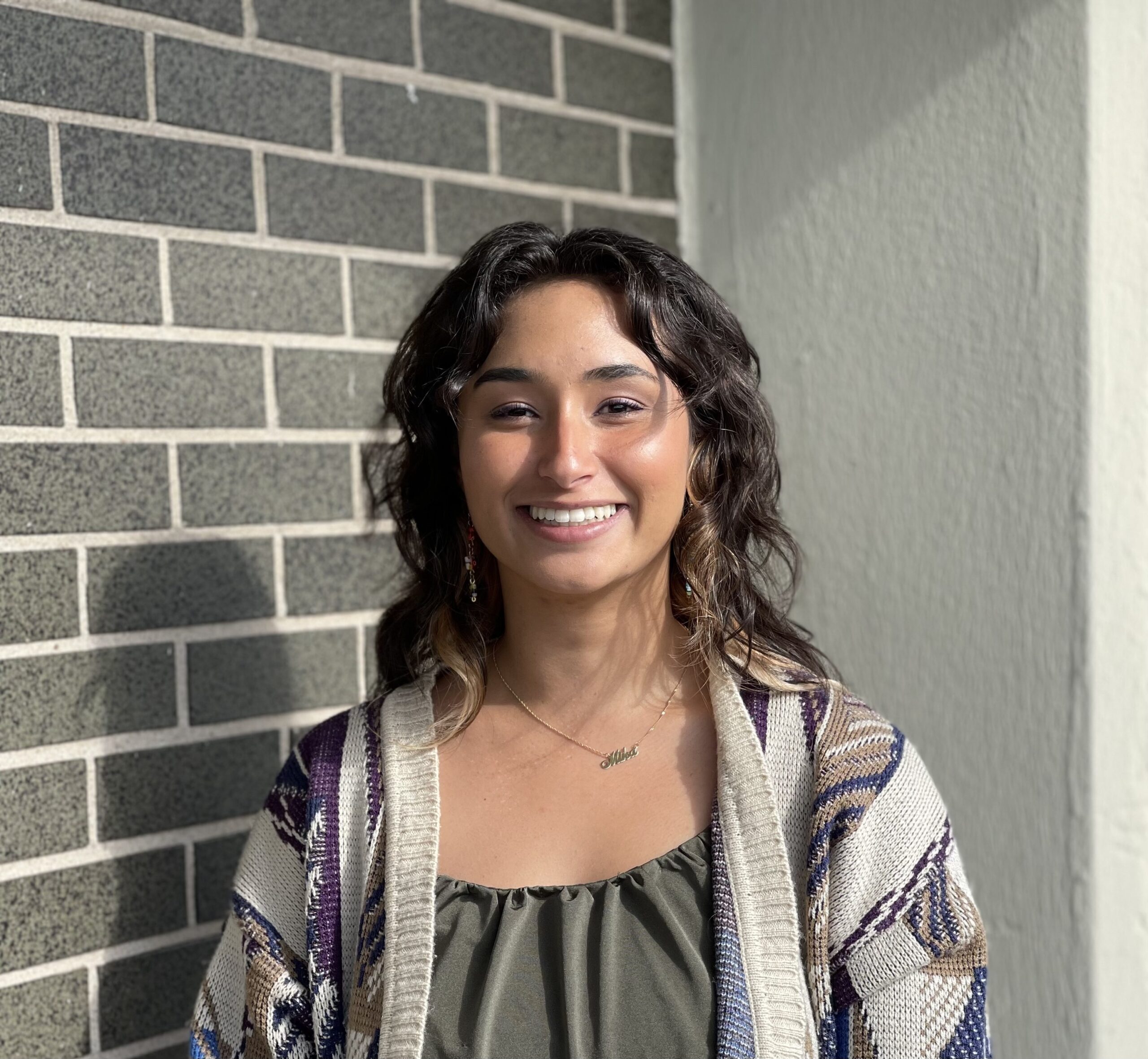
Mika Alexander, philanthropy coordinator, joined the department in July 2025. Mika previously served as the ACLU of Colorado’s Public Policy Fellow, assisting the public policy department in advancing civil rights legislation. Mika graduated from Colorado College with a Bachelor of Arts in Anthropology.
Scott Medlock, senior staff attorney, joined the ACLU of Colorado in July 2025. Scott has practiced law since 2005 and began his legal career with the Texas Civil Rights Project. Scott then practiced for eight years with the civil rights and personal injury firm Edwards Law in Austin, Texas. Scott secured numerous landmark legal victories, including protections for elderly and disabled people in prison, settlements for wrongful death cases, and one of the largest civil rights jury verdicts in the Texas Panhandle. He returned to Colorado in 2021 to practice civil rights and employment law with King & Greisen in 2021, before founding Greisen Medlock in 2023. Scott is a graduate cum laude of Northwestern University, and with honors of the University of Texas School of Law.
Kara Narberes, paralegal, joined the ACLU of Colorado in July 2025. She previously worked as a paralegal in Tucson, Arizona. Kara graduated from the University of Arizona with dual degrees in Political Science with an emphasis in Law and Public Policy and Statistics and Data Science with a Minor in Economics.

Ariane Frosh, policy counsel, joined the ACLU of Colorado in December 2025. Prior to joining the ACLU, Ariane represented tenants in eviction and fair housing cases as a housing attorney at the Colorado Poverty Law Project and led the organization’s Gender Advocacy in Housing Initiative. Ariane is a graduate of Beloit College and the University of Colorado Law School.